Microsoft Products: From Inception to Innovation
1. The First Product: BASIC for Altair 8800 (1975)
- Microsoft’s journey began with a version of BASIC, a programming language interpreter for the Altair 8800 microcomputer.
- This product was created by Bill Gates and Paul Allen before Microsoft was formally incorporated.
- It marked the beginning of Microsoft’s focus on software for personal computing.
2. MS-DOS and Early Operating Systems (1980s)
- In 1981, Microsoft released MS-DOS (Microsoft Disk Operating System), bundled with IBM PCs.
- MS-DOS became the foundation for Microsoft’s dominance in operating systems.
- In 1985, Microsoft introduced Windows 1.0, a graphical shell for MS-DOS.
3. Microsoft Windows Series
- Windows 3.0 (1990): Introduced improved UI and multitasking.
- Windows 95 (1995): Revolutionized desktop computing with the Start menu and plug-and-play support.
- Windows XP (2001): Known for stability and user-friendly design.
- Windows Vista, 7, 8, 10: Each brought UI changes, security upgrades, and performance improvements.
- Windows 11 (2021): Modern design, Snap Layouts, and deeper cloud integration.
4. Microsoft Office Suite
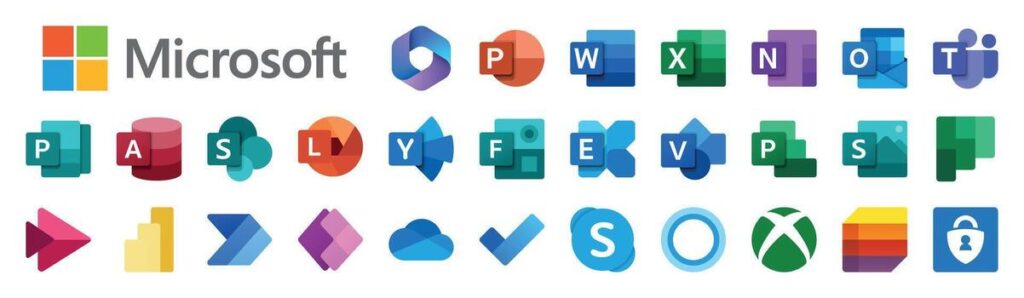
- Launched in 1990, Microsoft Office bundled Word, Excel, and PowerPoint.
- Expanded to include Outlook, Access, OneNote, and Publisher.
- Now offered as Microsoft 365, with cloud-based collaboration and AI-powered features.
5. Internet and Web Services
- Internet Explorer (1995): Dominated web browsing until the rise of Chrome and Firefox.
- Microsoft Edge (2015): A modern browser built on Chromium, replacing IE.
- Bing (2009): Microsoft’s search engine, integrated with AI and Microsoft services.
6. Developer Tools and Platforms
- Visual Studio (1997): Integrated development environment (IDE) for building applications.
- .NET Framework (2002): Platform for building Windows and web applications.
- GitHub (acquired 2018): Popular code hosting platform for developers.
7. Cloud and Enterprise Solutions
- Microsoft Azure (2010): Cloud computing platform offering IaaS, PaaS, and SaaS.
- Dynamics 365: CRM and ERP applications for business management.
- Power Platform: Includes Power BI, Power Apps, and Power Automate for low-code solutions.
8. Communication and Collaboration
- Skype (acquired 2011): VoIP and video calling service.
- Microsoft Teams (2017): Unified communication and collaboration platform, now central to Microsoft 365.
- Outlook: Email client and calendar tool, integrated across devices.
9. Gaming and Entertainment
- Xbox (2001): Microsoft’s gaming console, followed by Xbox 360, Xbox One, and Xbox Series X|S.
- Game Pass: Subscription service offering access to a library of games.
- Activision Blizzard (acquired 2023): Major expansion into gaming content and studios.
10. Hardware Innovations
- Surface Line (2012): Includes Surface Pro, Surface Laptop, Surface Studio, and Surface Duo.
- HoloLens (2016): Mixed reality headset for enterprise and developer use.
- Accessories: Keyboards, mice, webcams, and other peripherals.
11. AI and Emerging Technologies
- Copilot (2023): AI assistant integrated into Microsoft 365, GitHub, and Windows.
- Azure OpenAI Service: Enables developers to build with GPT models and other AI tools.
- Project Silica and Quantum Computing: Experimental technologies for future data storage and processing.
Conclusion
Microsoft’s product evolution reflects its commitment to innovation, adaptability, and user empowerment. From BASIC to Copilot, each product has shaped the way people work, play, and connect. Today, Microsoft stands at the forefront of cloud computing, AI, and digital collaboration—continuing to redefine the future of technology.